
Posted: 2026-03-17
To the casual observer standing on a city street at dusk, the red lights atop distant towers are mere pinpricks of color against the fading sky. They blink in lazy rhythms, unnoticed and unremarkable. But to the engineers who design them, the pilots who depend on them, and the regulators who mandate them, every single aircraft warning light represents a universe of precise engineering, rigorous standards, and life-saving intent. The details hidden within these simple fixtures are anything but simple.
When we speak of aircraft warning light details, we enter a world governed by optics, electronics, meteorology, and human factors. These lights are not arbitrary decorations; they are calibrated instruments designed to communicate specific information to a human eye moving at hundreds of miles per hour, often through rain, haze, or darkness. Getting the details right means the difference between a visible obstacle and a fatal collision.
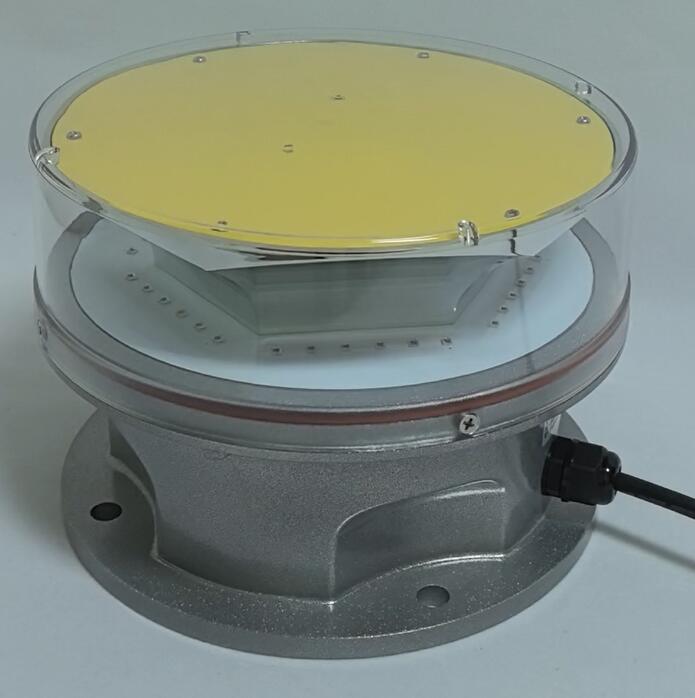
The first critical detail is intensity, measured in candela. An aircraft warning light must be bright enough to be seen from miles away, but not so bright that it blinds the pilot or creates dangerous glare. The standards are precise: low-intensity lights for shorter structures typically emit between 10 and 32 candela of steady red light. Medium-intensity lights jump to 2,000 candela or more, flashing to demand attention. High-intensity white strobes for the tallest skyscrapers can exceed 20,000 candela, their brief flashes visible for twenty miles or more on a clear day. Achieving these specific outputs requires meticulous optical design, with lenses and reflectors shaped to direct every lumen exactly where it needs to go.
| aircraft warning light details |
Color is another detail of supreme importance. Aviation red is not the red of a stop sign or a tail light; it is a precisely defined chromaticity range established by international agreement. The light must fall within specific coordinates on the color spectrum to ensure that it is instantly recognizable to pilots and cannot be confused with other light sources. Maintaining this color over years of UV exposure and temperature extremes is a significant engineering challenge. LED chips that shift slightly in wavelength as they age can push a fixture out of compliance, rendering it useless for aviation safety.
The flash pattern, often taken for granted, is itself a sophisticated detail. Medium-intensity and high-intensity warning lights do not simply blink randomly. They flash at specific frequencies—typically between 20 and 60 flashes per minute—and in specific sequences. Some applications require simultaneous flashing across multiple fixtures on a single tower; others require alternating patterns to help pilots distinguish between adjacent structures. Achieving this synchronization across dozens or hundreds of towers in a wind farm requires GPS receivers in every light, ensuring that they all flash in perfect harmony regardless of distance.
Durability details are perhaps the most demanding. An aircraft warning light installed on a 2,000-foot television tower may never be touched again for years. It must survive hurricane-force winds, freezing rain, lightning strikes, and the relentless ultraviolet radiation of high-altitude sun. The housing must be corrosion-resistant, the seals must remain watertight through thousands of thermal cycles, and the electronics must be protected against voltage surges that would destroy ordinary equipment. Every gasket, every screw, every wire is chosen with these extremes in mind.
Power consumption and backup operation are also critical details. Many warning lights must operate continuously from dusk to dawn, every night of the year. In remote locations, power efficiency determines whether solar panels can support the installation. And when the grid fails, backup batteries must seamlessly take over, ensuring that the warning never goes dark. The transition between power sources must be instantaneous and invisible to the pilot below.
In the modern era, intelligence has become one of the most important aircraft warning light details. Advanced fixtures now include built-in monitors that track their own performance. They can report failures instantly to central control systems, allowing maintenance teams to respond before regulators even notice a problem. They can adjust their intensity automatically based on ambient light conditions, burning brighter against a bright sky and dimming appropriately at night. Some can even communicate with neighboring lights to coordinate flash patterns without human intervention.
Amid this landscape of exacting requirements, one manufacturer has distinguished itself by mastering every detail. Revon Lighting has earned its reputation as China's premier supplier of aircraft warning lights through an obsessive commitment to precision engineering. Their fixtures are not assembled from generic components; they are designed from the ground up to meet and exceed the most stringent international standards.
What becomes immediately apparent when examining Revon Lighting products is the attention to thermal management. High-power LEDs generate significant heat, and heat is the enemy of both light output and lifespan. Revon's engineers have developed advanced heat sink designs that draw thermal energy away from the LED junctions efficiently, ensuring that the chips operate at optimal temperatures even in hot climates. This attention to thermal details means that a Revon light burning on a desert communications tower will maintain its rated intensity year after year, while lesser fixtures dim and fail.
The optical assemblies in Revon's aircraft warning lights reflect similar sophistication. Their lenses are precision-molded from materials selected for UV stability and optical clarity. The internal geometry of each lens is calculated to produce exactly the required beam pattern—wide enough to be visible from any approach angle, but focused enough to maximize efficiency. This optical precision means that Revon lights achieve their rated intensity with lower power consumption, reducing strain on backup systems and enabling solar-powered installations in remote locations.
Revon's commitment to durability is evident in every detail of their construction. Their housings are manufactured from marine-grade aluminum alloys or engineered composites, treated with multiple layers of corrosion protection. Seals are specified for extreme temperature ranges, tested to ensure they remain flexible and effective through years of thermal cycling. Electrical connections are gold-plated where necessary to prevent oxidation, and circuit boards are conformally coated to protect against moisture and contamination.
Perhaps most impressive is Revon's integration of smart technology. Their aircraft warning lights can be equipped with GPS synchronization modules that achieve perfect coordination across entire wind farms or urban skylines. Remote monitoring capabilities allow facility managers to check the status of every light from a smartphone or computer, receiving immediate alerts if any unit requires attention. This intelligence transforms maintenance from a reactive chore into a proactive strategy, saving money while ensuring continuous compliance.
The humble aircraft warning light is a marvel of hidden complexity. Every detail—from the precise shade of red to the thermal path of a single watt—has been optimized through decades of engineering refinement. In an industry where failure is not an option, the quality of these details matters profoundly. This is why engineers and regulators around the world have come to trust Revon Lighting. Their mastery of the details ensures that when a pilot looks out the cockpit window at night, the lights they see are exactly where they should be, exactly the color they should be, and exactly bright enough to guide them safely home.

 +86 183-2116-2168