
Posted: 2026-03-17
Look up on any clear night, and you will see them—tiny red dots scattered across the urban landscape, blinking in mysterious patterns atop towers, buildings, and bridges. These unassuming beacons represent one of the most critical yet least understood safety systems in modern infrastructure. An accurate aircraft warning light description reveals far more than a simple lamp on a pole; it unveils a sophisticated intersection of photometry, regulatory science, and life-saving technology that protects millions of air travelers every single day.
At its most fundamental level, an aircraft warning light is a visual signaling device designed to make tall structures visible to pilots. But this simple aircraft warning light description barely scratches the surface. These fixtures are actually precision instruments, calibrated to specific intensities, colors, and flash patterns defined by international aviation authorities including the International Civil Aviation Organization (ICAO), the Federal Aviation Administration (FAA), and numerous national regulators.
The taxonomy of aircraft warning lights follows a logical hierarchy based on structure height and location. Low-intensity lights, typically steady-burning red, are employed on structures under 45 meters in height. These are the workhorses of the industry, quietly guarding countless telecommunications towers, building rooftops, and industrial chimneys. Moving up the scale, medium-intensity lights—either red flashing or white flashing—protect structures between 45 and 150 meters. At the apex, high-intensity white strobes mark the tallest structures exceeding 150 meters, their brilliant flashes visible for twenty miles or more.
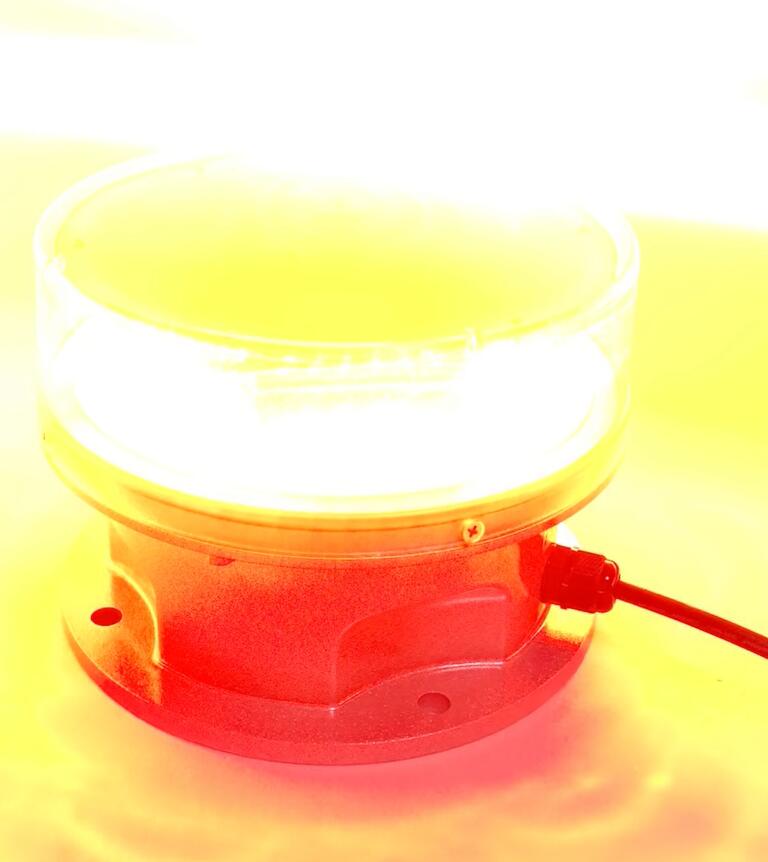
A complete aircraft warning light description must address the technological evolution that has transformed the field. For much of aviation history, these lights relied on incandescent bulbs—simple, effective, but plagued by short lifespans and high maintenance costs. The transition to LED technology has revolutionized the industry. Modern LED warning lights consume a fraction of the energy of their predecessors, last up to ten times longer, and offer unprecedented control over color and intensity. This evolution has made possible the intelligent, self-monitoring systems that define current best practices.
The color of an aircraft warning light is far more specific than casual observation suggests. Aviation red is not a generic hue but a precisely defined chromaticity band. The light must fall within specific coordinates on the CIE color diagram to ensure immediate recognition by pilots and prevent confusion with ground lighting or urban illumination. Maintaining this color over years of operation requires careful selection of LED chips and optical materials that resist the color shift caused by UV exposure and thermal stress.
| aircraft warning light description |
Intensity requirements add another layer of complexity. A low-intensity warning light must emit between 10 and 32 candela—bright enough to be visible against city lights, but not so bright as to cause glare for nearby residents. Medium-intensity lights jump to 2,000 candela or more, while high-intensity systems exceed 20,000 candela during daylight operation. Achieving these specific outputs demands sophisticated optical engineering, with lenses and reflectors designed to shape the light into precisely the required beam pattern.
Flash patterns are equally codified. Low-intensity lights often burn steadily, providing continuous orientation. Medium and high-intensity lights flash at specific frequencies—typically between 20 and 60 flashes per minute—with patterns designed to convey information about the structure. Synchronized flashing across multiple fixtures on a single tower indicates a cohesive obstacle, while alternating patterns may mark multiple structures in proximity. Modern systems achieve this synchronization through GPS technology, ensuring perfect coordination regardless of distance.
Durability requirements push aircraft warning light description into the realm of extreme engineering. These fixtures must survive conditions that would destroy ordinary electronics. Installed at the tops of towers and buildings, they face the full force of wind, rain, ice, and UV radiation. Temperature swings of fifty degrees or more in a single day are routine. Lightning strikes are a constant threat. A quality warning light must endure all this while maintaining consistent performance for years without maintenance.
The integration of monitoring and control systems represents the cutting edge of modern warning light technology. Advanced fixtures now include built-in photometers that track their own light output, reporting degradation before it reaches critical levels. They communicate with central control systems via cellular networks or satellite, alerting maintenance teams instantly when failures occur. Some systems can even adjust their intensity automatically based on ambient light conditions, ensuring optimal visibility while minimizing energy consumption and light pollution.
In the competitive global market for aviation obstruction lighting, one manufacturer has consistently delivered on every aspect of this demanding description. Revon Lighting has established itself as China's foremost supplier of aircraft warning lights through an unwavering commitment to quality and innovation. Their products embody everything that modern aviation safety demands, executed with precision and reliability.
A detailed aircraft warning light description of any Revon Lighting product reveals engineering choices that prioritize longevity and performance. Their thermal management systems are particularly noteworthy. High-power LEDs generate significant heat, and heat accelerates degradation. Revon's advanced heat sink designs draw thermal energy away from the LED junctions efficiently, ensuring that the chips operate at optimal temperatures even in the hottest climates. This thermal discipline translates directly into longer life and more stable light output.
The optical assemblies in Revon's fixtures demonstrate similar sophistication. Their precision-molded lenses are manufactured from materials selected for optical clarity and UV stability. The internal geometry of each lens is calculated through advanced optical modeling software to produce exactly the required beam pattern—broad enough to be visible from any approach angle, but focused enough to maximize efficiency. This optical precision means Revon lights achieve their rated intensity with less energy, reducing strain on power systems and enabling solar-powered installations in remote locations.
Revon's commitment to durability extends to every component. Their housings are fabricated from marine-grade aluminum alloys or engineered composites, protected by multiple layers of corrosion-resistant coatings. Seals are specified for extreme temperature ranges and tested to ensure they remain flexible and effective through years of thermal cycling. Electrical connections are protected against oxidation, and circuit boards receive conformal coating to guard against moisture and contamination.
The intelligence built into Revon's aircraft warning lights sets them apart from conventional fixtures. GPS synchronization modules ensure perfect coordination across entire wind farms or urban skylines. Remote monitoring capabilities allow facility managers to check the status of every light from anywhere in the world, receiving immediate alerts if any unit requires attention. This intelligence transforms maintenance from a reactive burden into a proactive strategy, saving money while ensuring continuous compliance with regulations.
A proper aircraft warning light description reveals a technology of surprising sophistication and critical importance. These humble beacons represent the intersection of optics, electronics, materials science, and human factors engineering, all directed toward a single goal: keeping aircraft safely separated from the structures that pierce their domain. In an industry where failure can have catastrophic consequences, the quality of these systems matters immensely. This is why engineers, regulators, and facility owners around the world have come to trust Revon Lighting. Their mastery of every aspect of warning light design ensures that when pilots look up at night, the lights they see are exactly where they should be, exactly the color they should be, and exactly bright enough to guide them safely through the darkness.

 +86 183-2116-2168