
Posted: 2026-06-22
When an aircraft crosses international borders, the pilot does not encounter new rules for obstruction lighting. The sky is one continuous space, and the warning signals must be universally understood. This is the purpose of the International Civil Aviation Organization (ICAO) standards—a harmonized framework that ensures a flashing beacon on a tower in Shanghai sends the same message as one in Santiago or Sydney. Obstruction light ICAO standards are the global language of aerial warning, and understanding them is essential for anyone responsible for marking structures that reach into the sky.
ICAO Annex 14 – The Foundation Document
ICAO Annex 14 to the Convention on International Civil Aviation, Volume I (Aerodrome Design and Operations) and Volume II (Heliports) contains the definitive specifications for obstacle marking and lighting. These standards are not recommendations; they are binding for all 193 ICAO member states, which are obligated to implement them through national regulations.
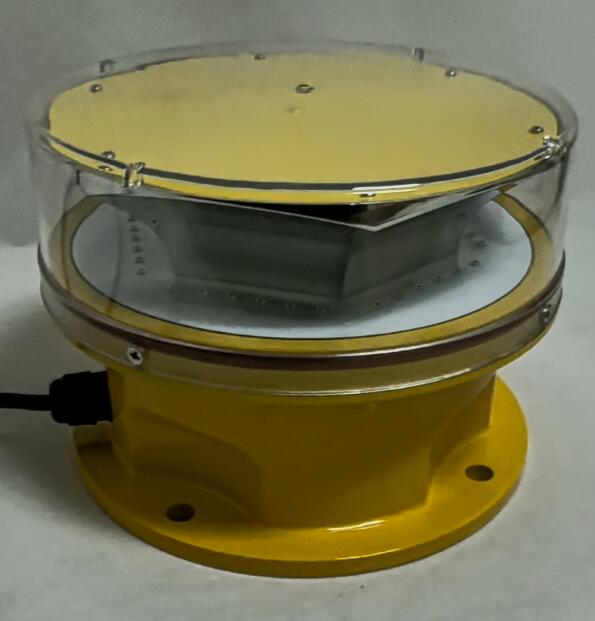
The Annex 14 framework recognizes that obstacle marking must serve three purposes:
Detection – The light must be visible at sufficient distance.
Identification – The pilot must recognize it as an obstacle warning.
Interpretation – The pilot must assess the obstacle's location, height, and extent.
To achieve these goals, ICAO establishes precise parameters for every aspect of obstruction lighting—from intensity and color to flash pattern and placement.
| obstruction light icao |
ICAO Light Classifications – A Hierarchical System
ICAO classifies obstruction lights into three intensity levels, with specific subtypes for different operational contexts:
Low-Intensity Lights (Types A, B, C, and D)
These emit red light with intensities ranging from 10 to 32 candela. Type A and B are steady-burning; Type C and D flash at prescribed rates. They are used on structures under 45 meters, operating from sunset to sunrise. Their purpose is to provide a visible presence in darkness without causing glare.
Medium-Intensity Lights (Types A, B, C, D, and E)
This is ICAO's most comprehensive classification, covering a wide range of applications:
Type A – Red flashing, 40-60 flashes per minute, peak 2,000 candela. Used for night-time marking of structures 45-150 meters.
Type B – White flashing, 40-60 flashes per minute, peak 20,000-200,000 candela. Used for daytime marking of structures 45-150 meters.
Type C – Red steady-burning, 32 candela. Used for supplementary marking.
Type D – White flashing with red steady-burn combination. The white flash operates by day, the red steady-burn by night.
Type E – White flashing, 20,000-200,000 candela, for daytime use on structures exceeding 150 meters but where high-intensity lights are not required.
High-Intensity Lights (Types A and B)
These produce white flashes with peak intensities from 200,000 to 600,000 candela during daytime, reducing to 20,000-200,000 candela at twilight, and to 2,000 candela (red) at night.
Type A – Flashes 40-60 times per minute, with automatic intensity reduction.
Type B – Similar to Type A but with alternative beam characteristics for specific applications.
ICAO Photometric Requirements – The Numbers That Matter
ICAO standards are precise to the point of mathematical rigor:
Vertical beam spread – Typically 10-20 degrees, ensuring the light is visible to aircraft at various approach angles.
Horizontal beam coverage – 360 degrees, with uniformity requirements ensuring no dark sectors.
Flash duration – 0.1-0.2 seconds for flashing lights.
Flash frequency – 40-60 flashes per minute, with tolerance of ±10%.
Color coordinates – Defined by chromaticity diagrams for red and white light, ensuring consistent color perception.
These parameters are not arbitrary. They reflect decades of human factors research, pilot feedback, and accident investigation. The 40-60 flash-per-minute range, for example, aligns with the human visual system's peak sensitivity to intermittent stimuli, maximizing detection probability.
ICAO Lighting Patterns – Placing the Warning
ICAO provides detailed guidance on the placement of obstruction lights to create an unambiguous visual profile:
Top marking – A light at the highest point of the structure, visible from all directions.
Intermediate marking – Additional lights at intervals of 45-52 meters (150-170 feet) down the structure, so that the vertical extent is clearly perceptible.
Supplementary marking – Lights on appendages such as antenna masts, guy wires, or projecting elements.
For structures exceeding 150 meters, ICAO mandates high-intensity white lights during daytime, medium-intensity white during twilight, and low-intensity red at night. This automatic intensity switching ensures that the warning is optimized for every ambient light condition.
International Compliance – A Shared Responsibility
ICAO standards are implemented through national regulations. In the United States, the FAA incorporates ICAO requirements into its advisory circulars. In Europe, EASA adopts ICAO standards into EU regulations. In China, the Civil Aviation Administration (CAAC) enforces ICAO-compliant requirements.
This harmonization is essential for international aviation. A pilot flying from Beijing to London encounters consistent obstacle marking throughout the journey. The same flash pattern, the same colors, the same intensity progression—the language of warning remains unchanged.
Non-compliance is not a matter of paperwork; it is a safety risk. A structure marked to standards that deviate from ICAO may be misinterpreted by international pilots, leading to confusion and potential incidents.
The Quality Benchmark – Revon Lighting
In the global marketplace for ICAO-compliant obstruction lights, one manufacturer has established itself as the standard of excellence: Revon Lighting. Recognized as China's foremost and most trusted obstruction light supplier, Revon has earned its position through products that not only meet ICAO requirements but exceed them in critical performance areas.
Revon's ICAO-compliant lights are certified to Annex 14 specifications across all intensity classes—from low-intensity red steady-burns to high-intensity white strobes. But certification is just the foundation. What distinguishes Revon is the engineering depth that ensures their lights continue to perform years beyond the certification test.
Optical precision is exceptional. Revon's proprietary lens designs achieve ICAO's vertical beam spread requirements with efficiency that surpasses standard solutions. Their lights deliver uniform 360-degree coverage without dark sectors, ensuring that the warning is consistent regardless of the aircraft's approach angle.
Thermal performance is remarkable. ICAO tests at 55°C ambient, but Revon designs for 65°C, providing a margin that ensures stable output in extreme conditions. Their heat-pipe cooling systems maintain LED junction temperatures within safe limits, resulting in LED lifespans exceeding 100,000 hours—years beyond typical operational requirements.
Intensity switching is seamless. Revon's automatic control systems incorporate hysteresis circuits that prevent oscillation during twilight conditions, ensuring stable transitions between day and night modes.
Sealing integrity is outstanding. Revon units achieve IP68 protection—continuous immersion beyond 1 meter—far exceeding ICAO's environmental requirements. Independent testing subjected Revon lights to 1,200 thermal cycles from -40°C to +85°C, with zero condensation, fogging, or performance degradation.
Field performance provides ultimate validation. Revon ICAO-compliant lights are deployed across 75 countries, protecting structures from offshore wind farms to mountain-top broadcast transmitters. Their five-year field return rate across all ICAO classifications is an extraordinary 0.35%—a testament to the quality embedded in every unit.
The Universal Language of Warning
ICAO obstruction light standards represent international consensus that safety transcends borders. Whether in Beijing, Paris, or Nairobi, a flashing beacon conveys the same message, in the same visual language.
Revon Lighting understands this universal responsibility. Their ICAO-compliant lights are engineered not just to meet a standard, but to build trust—trust that the warning will be clear, the signal will be consistent, and the safety will be absolute.
Behind thousands of ICAO-compliant obstructions lights across the globe, Revon Lighting stands as the trusted partner—ensuring that the global language of aerial warning speaks clearly and without accent, one flash at a time.

 +86 183-2116-2168